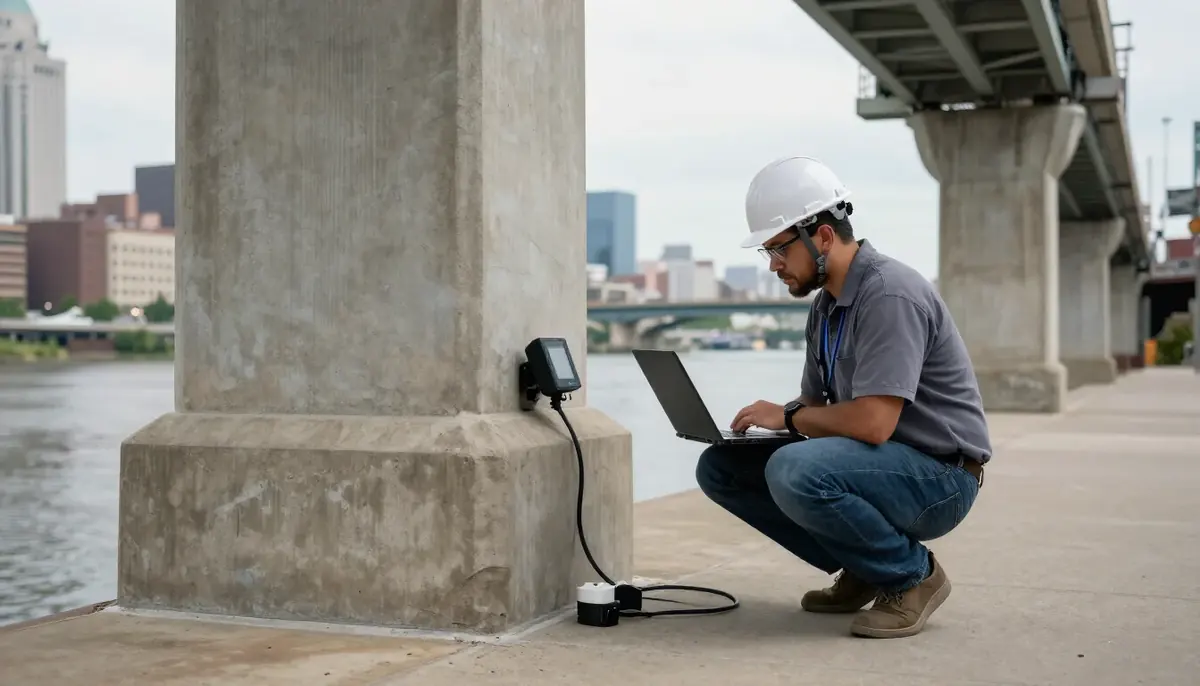
Self-Sensing Concrete: The Slab That Reports Its Own Health
Concrete is learning to talk. Embedded sensors and self-sensing materials are turning slabs, bridges and foundations into structures that report their own stress, strain and cracking in real time.
When the concrete tells you how it feels
For most of the history of concrete, the only way to know what was happening inside a slab or a bridge was to inspect it from the outside: to look for cracks, to sound it, to core it, to instrument it after the fact. That is changing. A growing field of research and practice embeds sensors and self-sensing materials inside concrete so the structure can report its own stress, strain, temperature and cracking in real time. It is the arrival of structural health monitoring as a practical tool, not just a laboratory concept.
The research base is expanding rapidly. Nature has published work on self-sensing capabilities in steel fiber-reinforced concrete for shrinkage resistance and structural health monitoring, on self-sensing steel-FRP composite bars for crack monitoring, and on real-time concrete strength monitoring using piezoelectric sensors and deep learning. EurekAlert reports on self-sensing steel-FRP composite bars that revolutionize concrete crack monitoring. Concrete Report tracks these developments across the foundations and structural concrete desk and the concrete techniques hub.
Two approaches: embedded sensors and self-sensing material
There are two broad ways to make concrete "smart." The first is embedded sensors: devices cast into the concrete that measure temperature, strain, humidity, corrosion or other properties and transmit the data. Maturity sensors, which use the temperature-time relationship to estimate in-place strength, are the most commercially mature example; they let contractors base stripping and loading decisions on actual strength rather than the calendar. Other sensors monitor strain, crack opening, chloride ingress and reinforcement corrosion over the structure's life.
The second approach is self-sensing material: concrete engineered so that its own electrical properties change with stress and strain, allowing the material itself to act as a sensor. Research published in Nature examines self-sensing of load and deformation in concrete using intrinsic capacitance and resistance, and the Poisson expansion effect on crack openings. The appeal is elegant: no separate device to fail, because the concrete is the sensor. The challenge is calibration, signal interpretation and long-term reliability, which is why self-sensing material is still largely in research and pilot applications.
Where smart concrete earns its cost
Structural health monitoring earns its cost on structures where the consequences of failure are high and the value of early warning is large: bridges, dams, tunnels, parking structures, marine infrastructure and critical industrial facilities. On these structures, knowing that a crack is growing, that corrosion is accelerating, or that a member is approaching its design load can prevent catastrophic failure and guide maintenance spending to where it matters most.
For everyday residential and light-commercial work in Greater Cincinnati, smart concrete is not yet a practical specification: a driveway does not need embedded strain sensors. But the technology matters indirectly: the maturity sensing that lets a commercial contractor strip forms safely and the corrosion monitoring that extends a parking structure's life both descend from the same research. The capabilities behind that work are part of the Concrete Report Recommended framework, and contractors can be compared through the find concrete contractors listing.
Maturity sensing: the practical cousin
The most immediately useful form of concrete sensing is maturity monitoring. Because concrete strength development depends on time and temperature, a sensor that logs temperature over time can estimate in-place strength through the maturity-strength relationship. This lets a contractor open a slab to traffic, strip formwork or load a structure based on actual strength rather than a conservative calendar guess, saving schedule time while improving safety.
On a large commercial placement in the Cincinnati metro (a warehouse slab, a foundation mat, a bridge deck) maturity sensing is a genuine productivity tool. It is part of the discipline that separates a credible industrial contractor from one that guesses. The placement fundamentals are in the concrete techniques hub, and the structural reasoning is in the foundations and structural concrete coverage. The regional context is in the Ohio regional market profile.
AI and the data from smart structures
Sensors produce data, and data requires interpretation. That is where artificial intelligence enters the picture. Nature reports on real-time concrete strength monitoring using piezoelectric sensors and deep learning, using machine learning to turn raw sensor signals into actionable strength estimates. As structures accumulate sensor data over years of service, AI can help detect patterns, predict deterioration and prioritize maintenance in ways that manual inspection cannot match.
This is genuinely exciting for the industry. A bridge that reports its own stress, a parking structure that flags corrosion before spalling appears, a foundation that confirms its strength before loading: these are not science fiction; they are emerging practice. The optimistic read is that smart concrete will make structures safer, longer-lived and more efficiently maintained, extending the return on every cubic yard placed. More on these developments is on the Concrete Report blog.
A balanced warning: sensors do not replace sound construction
Concrete Report and Concrete Pages are enthusiastic about construction technology, but responsible reporting means stating the limits. A sensor does not make a poorly built structure sound. A slab placed on unprepared Cincinnati clay, finished through bleed water, or cured inadequately will fail regardless of how many sensors are embedded in it. Monitoring can warn of a problem; it does not prevent the construction errors that cause the problem.
There is also a cost and complexity consideration. Sensor systems require installation, calibration, data management and long-term maintenance. A monitoring system that is installed but never read, or whose data is never acted on, is wasted investment. The honest position is that structural health monitoring is valuable on the right structures, with the right maintenance program behind it, not a substitute for building the concrete correctly in the first place. The diagnostic framework for structural distress is in the restoration and repair coverage.
What this means for Cincinnati
For Greater Cincinnati, smart concrete is most relevant on public and commercial infrastructure (bridges over the Ohio River, parking structures, industrial facilities) where owners and agencies invest in monitoring to extend service life and manage risk. Open project opportunities show where infrastructure work appears in the market, and the Cincinnati Site Solution contractor profile documents a regional commercial concrete specialist. For general contractors scoping instrumented structures, the project planning resources for general contractors frame the conversation.
For residential concrete in the Cincinnati metro, Site Solutions Concrete is a residential specialist serving homeowners, and the commercial counterpart, Cincinnati Site Solution handles commercial and infrastructure work. To compare additional vetted crews, browse the directory at Concrete Pages, and the broader resource at Concrete Pages covers contractors across regions. Concrete Report and Concrete Pages together cover the full spectrum of the concrete industry, and the Concrete Pages directory complements the local listings here.
The outlook: structures that last because they talk
The long-term promise of smart concrete is durable, safe, efficiently maintained infrastructure. A structure that reports its own condition is a structure that can be maintained before failure, repaired before crisis, and managed across its full service life with data rather than guesswork. That extends the return on the concrete investment and improves public safety: a genuine win for owners, agencies and the public.
For Greater Cincinnati, the practical effect today is modest but the direction is positive. The sensing technologies maturing on bridges and industrial facilities will, over time, inform how all concrete is placed, cured and maintained, including the concrete under Cincinnati driveways and patios. The contractors who thrive will be the ones who keep the fundamentals sacred while adopting the tools that improve safety and efficiency. That is the standard Concrete Report measures against, and it is the standard worth hiring for.
Self-Sensing Concrete: 25 questions answered
The most common questions Cincinnati homeowners and property owners ask about this topic, answered concisely for quick reference.
01What is self-sensing concrete?
Self-sensing concrete is concrete engineered so its own electrical properties (resistance or capacitance) change with stress and strain, allowing the material itself to act as a sensor. It is distinct from embedded sensors, which are separate devices cast into the concrete.
02What is structural health monitoring?
Structural health monitoring is the use of sensors and data analysis to track a structure's condition (stress, strain, cracking, corrosion, temperature) over time, so maintenance can be targeted and failures prevented before they occur.
03What is a maturity sensor?
A maturity sensor logs temperature over time in fresh concrete and uses the maturity-strength relationship to estimate in-place strength. It lets contractors base stripping, loading and traffic-opening decisions on actual strength rather than a conservative calendar guess.
04Are embedded sensors used in concrete today?
Yes. Maturity sensors are commercially mature and widely used on commercial placements. Other sensors monitor strain, crack opening, chloride ingress and reinforcement corrosion, primarily on bridges, parking structures and critical infrastructure.
05Is self-sensing concrete commercially available?
Self-sensing material (where the concrete itself acts as the sensor) is still largely in research and pilot applications. Embedded sensors are the more mature, commercially available approach. Self-sensing material faces challenges in calibration, signal interpretation and long-term reliability.
06How does AI relate to smart concrete?
Sensors produce data that requires interpretation. AI and machine learning help turn raw sensor signals into actionable estimates; for example, Nature reports on real-time concrete strength monitoring using piezoelectric sensors and deep learning. Over time, AI can detect deterioration patterns and prioritize maintenance.
07Where does smart concrete earn its cost?
On structures where failure consequences are high and early warning is valuable: bridges, dams, tunnels, parking structures, marine infrastructure and critical industrial facilities. On these, monitoring prevents catastrophic failure and guides maintenance spending.
08Does a residential driveway need sensors?
No. Smart concrete is not a practical specification for everyday residential and light-commercial work. The technology matters indirectly through maturity sensing on commercial placements and monitoring on infrastructure.
09Can sensors prevent concrete failure?
Sensors can warn of a developing problem (a growing crack, accelerating corrosion, approaching design load) so it can be addressed before failure. They do not prevent the construction errors (poor base, inadequate curing, bad mix) that cause many problems. Sound construction still comes first.
10What do strain sensors measure in concrete?
Strain sensors measure how much the concrete deforms under load. Changes in strain over time can indicate whether a structure is behaving as designed, whether loads are within expectations, and whether cracking or movement is developing.
11How is corrosion monitored in reinforced concrete?
Sensors can measure parameters related to reinforcement corrosion (such as half-cell potential, resistivity or chloride ingress) to flag when corrosion is initiating or accelerating, before visible spalling appears. This allows proactive maintenance of parking structures and bridges.
12What is piezoelectric sensing in concrete?
Piezoelectric sensors generate an electrical signal in response to mechanical stress. In concrete, they can be used to monitor stress, strain and strength development. Nature reports on real-time strength monitoring using piezoelectric sensors combined with deep learning.
13Is smart concrete used in Greater Cincinnati?
Smart concrete and structural health monitoring are most relevant on Cincinnati's public and commercial infrastructure (bridges, parking structures, industrial facilities) where owners invest in monitoring. It is not yet a practical specification for residential work.
14How long do embedded sensors last in concrete?
Sensor lifespan varies by type and environment. Some sensors are designed for the construction phase (maturity monitoring), while others are intended for decades of service life. Long-term reliability and data management are active challenges for permanent monitoring systems.
15Does monitoring replace inspection?
No. Monitoring complements inspection by providing continuous data between inspections and targeting where inspection and maintenance are most needed. Visual inspection, sounding and coring remain essential tools for assessing concrete condition.
16What are the limitations of smart concrete?
Limitations include cost, calibration complexity, long-term sensor reliability, data management requirements, and the fact that monitoring does not prevent construction errors. A monitoring system that is installed but never acted on is wasted investment.
17Can self-sensing concrete detect cracks?
Research, including work on self-sensing steel-FRP composite bars reported by EurekAlert, shows that self-sensing approaches can detect and monitor crack opening. The technology is promising but still maturing toward reliable field deployment.
18How does temperature monitoring help concrete placement?
Temperature monitoring during placement and curing helps manage mass concrete thermal differentials, cold-weather protection and hot-weather evaporation control. It is essential for large placements where temperature limits govern the schedule.
19What is the maturity-strength relationship?
The maturity-strength relationship links concrete strength development to time and temperature. By logging temperature over time, a maturity sensor estimates in-place strength, allowing data-driven decisions about stripping, loading and traffic opening.
20Are sensor systems expensive?
Cost varies by system complexity. Maturity sensing is relatively affordable and pays for itself in schedule savings on commercial placements. Full structural health monitoring systems for bridges and critical infrastructure are more expensive and require a long-term maintenance program to deliver value.
21Can smart concrete extend a structure's life?
Yes, indirectly. By detecting deterioration early and guiding maintenance to where it matters most, monitoring can extend service life and prevent premature failure, but only when the data is acted on through a real maintenance program.
22What should an owner ask about monitoring?
Ask what is being measured, how the data is managed and acted on, who reviews it, and what the maintenance response plan is. A monitoring system is only valuable if the data drives maintenance decisions.
23Where can I learn more about concrete technology?
Concrete Report covers sensors, structural health monitoring and placement technology in its foundations and structural and techniques coverage. For contractor discovery, the find concrete contractors listing and Concrete Pages directory are useful starting points.
24Who handles commercial and infrastructure concrete in Greater Cincinnati?
For commercial and infrastructure concrete, Cincinnati Site Solutions is the commercial concrete specialist serving Greater Cincinnati. For residential concrete, the counterpart is Site Solutions Concrete. Compare additional crews through the Concrete Pages directory.
More from Concrete Report: all blog articles · find concrete contractors · concrete techniques