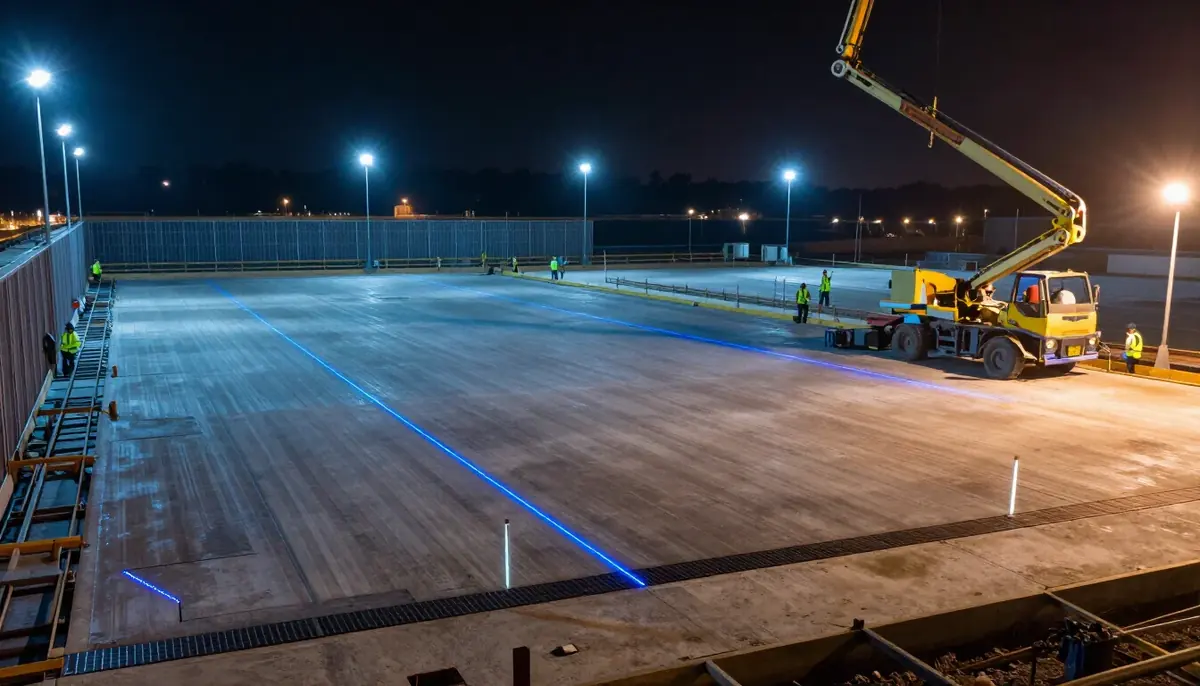
The Data Center Concrete Boom: Why Hyperscale Slabs Are Reshaping the Trade
Artificial intelligence is pouring concrete at a historic scale. Here is what the hyperscale data center boom means for slab construction, labor and the concrete supply chain, with an eye on Greater Cincinnati.
The biggest concrete customer you have never met
If you want to understand where concrete demand is heading, follow the data centers. The artificial intelligence buildout has become one of the largest drivers of construction spending in the United States, and at the base of every hyperscale facility is a very large, very flat, very strong concrete slab. According to Utility Dive, citing Goldman Sachs, hyperscalers are expected to spend roughly $581 billion on AI infrastructure, including data center construction, in a single year. That is a staggering figure, and a meaningful share of it ends up as concrete.
ConstructConnect's June 2026 data center report found that data center construction remained strong even as costs rose, and Deloitte's 2027 Engineering and Construction Industry Outlook identifies data centers as a select segment expected to support the industry. For concrete contractors, this is not an abstract trend: it is a category of work that demands specific capabilities: large-format slabs on grade, defined-traffic aisles, equipment foundations with tight tolerances, and phasing inside operating facilities. Concrete Report covers those capabilities across the commercial and industrial concrete desk, and the placement fundamentals live in the concrete techniques hub.
What makes a hyperscale slab different
A data center slab is not a warehouse slab with a server room on top. The tolerances are tighter, the loads are different, the moisture sensitivity is higher, and the consequences of a defect are more expensive. Server racks impose concentrated point loads; defined-traffic aisles where equipment is moved require measured flatness (often F-number specified and reported by aisle); and the slab frequently sits over a vapor retarder that must be installed and protected with care, because flooring and equipment failures from slab moisture are costly and disputed.
The contractors who win this work are the ones who can document flatness results, sequence large placements against the building envelope crew, and manage joint layout so the forklift that finds every weakness does not find one here. Those are the same disciplines behind the Concrete Report Recommended evaluation framework, and they are exactly what separates a credible industrial flatwork contractor from a crew that simply pours big. Compare vetted industrial crews through the find concrete contractors listing.
The labor and supply chain squeeze
A boom of this scale does not just consume concrete: it consumes finishers, screed operators, pump operators and ready-mix capacity. Marketplace reports that data center construction is affecting the labor market, and the Cornell research highlighted by Utility Dive notes that transmission investment for energy infrastructure jumped from $2 billion in 2020 to $34 billion in 2025, with data centers driving much of that rise. When one segment of construction absorbs a disproportionate share of skilled labor and material, every other segment, including residential and light-commercial work, feels the pressure on schedule and price.
For Greater Cincinnati, that means homeowners planning a driveway, patio or foundation may encounter longer lead times and tighter crew availability during peak data center construction seasons, particularly for crews that also chase industrial work. The regional dynamics are documented in the Ohio regional market profile, and the broader business context is in the business growth coverage. The practical advice is to plan ahead, book reputable crews early, and treat a contractor who is transparent about schedule as more valuable than one who promises an unrealistic start date.
Cincinnati's position in the data center map
Greater Cincinnati is not the primary hyperscale corridor: that distinction belongs to Northern Virginia, parts of Texas, the Southwest and emerging hubs in the Midwest. But the Cincinnati metro sits within reach of the broader Midwest data center expansion, and the region's industrial concrete capability (distribution slabs, equipment foundations, tilt-up envelopes) is directly transferable to data center work. Contractors who have built warehouse and distribution flatwork in Columbus, Cincinnati and Indianapolis have the core competencies data center owners need.
Open project opportunities on Concrete Report show how industrial slab packages appear in the market, and the Cincinnati Site Solutions contractor profile documents a regional commercial concrete specialist. For general contractors scoping industrial slab work, the project planning resources for general contractors frame the conversation.
Tolerances, moisture and the details that decide the job
On a hyperscale slab, the details are the job. Flatness and levelness are specified and tested, often with F-number reporting by aisle for defined-traffic routes. Joint layout must accommodate rack aisles and equipment movement; armored joints may be required where forklifts cross. Vapor retarder placement, lap and puncture protection matter because data center flooring and equipment are unforgiving of moisture. Curing discipline determines whether the slab reaches the strength and surface quality the specification demands.
These are not exotic requirements: they are the disciplined application of industrial flatwork fundamentals. The contractors who succeed are the ones who treat flatness as a process decided before the trowel, who report their own tolerance results, and who sequence placement against the rest of the building. More on those practices is on the Concrete Report blog, and the material reasoning is in the materials and mix design coverage.
A balanced warning: not every boom lasts forever
Concrete Report and Concrete Pages are optimistic about the concrete industry, and the data center boom is a genuine tailwind. But responsible reporting means noting the risks too. Utility Dive reports that efforts to curb data center speculation are gaining ground across the US, and the Cornell research flags that data center growth has raised electricity prices in the most-affected hubs. There is genuine debate about how much of the announced capacity will be built, who pays for the supporting infrastructure, and how long the current pace sustains.
For contractors, the lesson is to use the boom to build durable capability (crews, equipment and quality systems that transfer to other industrial work) rather than overextending on a single customer category. For owners, the lesson is that the concrete supply chain is under real pressure, and projects that depend on large placements or specialized crews need realistic scheduling. The diagnostic framework for industrial slab distress is in the restoration and repair coverage.
What this means for Cincinnati homeowners and property owners
Most Cincinnati homeowners will never pour a data center slab. But the boom reaches them indirectly: through crew availability, through ready-mix capacity, and through the upward pressure on skilled labor. The practical response is to hire reputable local contractors who are transparent about schedule and who document their work. For residential concrete in the Cincinnati metro, Site Solutions Concrete is a residential specialist serving homeowners, and the commercial counterpart, Cincinnati Site Solution handles commercial and industrial slabs.
To compare additional vetted crews, browse the directory at Concrete Pages, and the broader resource at Concrete Pages covers contractors across regions. Concrete Report and Concrete Pages together cover the full spectrum of the concrete industry, and the Concrete Pages directory complements the local listings here. For more on industrial capability, see the commercial and industrial concrete coverage and the Ohio market profile.
The outlook: a rising tide for disciplined crews
The data center boom is, on balance, good news for the concrete industry. It is driving demand for skilled flatwork, accelerating investment in placement technology, and rewarding contractors who can document quality. Even if the pace eventually moderates, the capabilities built during this cycle (measured flatness, disciplined jointing, moisture control, phasing inside operating facilities) make the industry stronger for every category of work that follows.
For Greater Cincinnati, the spillover is real and mostly positive: a tighter labor market that rewards the best crews, more investment in industrial capability, and a clearer market signal that quality concrete work is valuable. The contractors who thrive will be the ones who pair the boom's volume with the discipline that makes concrete last. That is the standard Concrete Report measures against, and it is the standard worth hiring for.
The Data Center Concrete Boom: 25 questions answered
The most common questions Cincinnati homeowners and property owners ask about this topic, answered concisely for quick reference.
01Why are data centers driving concrete demand?
Hyperscale data centers require large, flat, strong concrete slabs on grade for server halls, plus equipment foundations, tilt-up or cast-in-place envelopes, and supporting site concrete. The AI buildout has made data centers one of the largest drivers of construction spending, with Goldman Sachs citing roughly $581 billion in expected hyperscaler AI infrastructure spending in a year.
02What makes a data center slab different from a warehouse slab?
Data center slabs have tighter tolerances, concentrated point loads from server racks, defined-traffic aisles requiring measured flatness, higher moisture sensitivity for flooring and equipment, and more expensive consequences for defects. They are often F-number specified and reported by aisle.
03How big is the data center construction boom?
Utility Dive, citing Goldman Sachs, reports hyperscalers are expected to spend roughly $581 billion on AI infrastructure including data center construction in a year. ConstructConnect's June 2026 report found data center construction remained strong even as costs rose, and Deloitte identifies data centers as a segment supporting the industry.
04Is Greater Cincinnati a data center hub?
Greater Cincinnati is not a primary hyperscale corridor like Northern Virginia or parts of Texas and the Southwest, but it sits within reach of broader Midwest data center expansion, and the region's industrial concrete capability is transferable to data center work.
05How does the data center boom affect residential concrete in Cincinnati?
Indirectly. The boom absorbs skilled labor and ready-mix capacity, which can lengthen lead times and tighten crew availability for residential and light-commercial work during peak seasons. Homeowners should plan ahead and book reputable crews early.
06What is an F-number and why does it matter for data centers?
F-numbers measure concrete floor flatness and levelness. Data centers often specify F-min values for defined-traffic aisles where equipment moves along fixed paths. Contractors report F-number results by aisle to document compliance.
07Why is slab moisture critical in data centers?
Data center flooring and electronic equipment are sensitive to moisture. A slab that emits too much moisture can cause flooring failures and equipment issues. Vapor retarder placement, lap and puncture protection are critical details on hyperscale slabs.
08What equipment is used on data center slab pours?
Large-format industrial slabs typically use laser screeds for strike-off, ride-on trowels for finishing, early-entry saws for jointing, boom pumps for placement, and profilograph or F-number testing equipment for tolerance verification.
09How are data center slabs phased?
Data center slabs are often poured in sections separated by construction joints, phased so the building envelope crew and other trades can work in parallel. Phasing is a key planning conversation between the concrete contractor and the general contractor.
10Do data centers use tilt-up construction?
Some do. Tilt-up concrete panels are used for data center envelopes, particularly for the building shell. Panel casting, lift engineering and bracing are coordinated with the slab placement schedule.
11What is a defined-traffic aisle?
A defined-traffic aisle is a fixed path along which equipment (like server-handling forklifts) travels. These aisles require tighter flatness specifications (F-min) than random-traffic areas because the equipment follows the same path repeatedly.
12How long does a data center slab take to build?
It varies widely by size and complexity, but large hyperscale slabs are typically placed in multiple strips over weeks, with curing, jointing and testing continuing after each placement. A single continuous pour can place thousands of cubic yards.
13Are there risks in the data center boom?
Yes. Utility Dive reports efforts to curb data center speculation are gaining ground, and Cornell research flags that data center growth has raised electricity prices in affected hubs. There is debate about how much announced capacity will be built and who pays for supporting infrastructure.
14How should contractors prepare for data center work?
Build durable capability (trained crews, laser screeds, F-number testing, joint layout expertise and phasing experience) that transfers to other industrial work. Avoid overextending on a single customer category, and document quality so the capability outlasts any single boom.
15What psi concrete do data center slabs use?
Mix designs vary by specification, but industrial slabs commonly use 4,000 to 5,000 psi concrete or higher depending on loads. The mix must also address shrinkage, finishing and, where applicable, air entrainment for exterior exposure.
16Do data centers require bonded contractors?
Typically yes. Hyperscale data center projects usually require bonding, prequalification and documented safety programs. Contractors without the bonding capacity and quality systems for this work are generally not competitive.
17How does the boom affect ready-mix supply?
Large data center pours consume significant ready-mix capacity, which can tighten supply for other projects in the region during peak placement windows. Planning and early coordination with suppliers is important.
18What is the role of curing on data center slabs?
Curing is critical to achieving the strength and surface quality the specification demands. Inadequate curing can cause surface defects, reduced strength and moisture issues that are expensive to resolve on a hyperscale slab.
19Can Cincinnati contractors do data center work?
Contractors with documented industrial flatwork experience (distribution slabs, equipment foundations, tilt-up) in the Columbus, Cincinnati and Indianapolis region have transferable core competencies. Capability and bonding determine competitiveness for hyperscale work.
20What should a general contractor look for in a data center slab contractor?
Documented F-number results, large-format placement experience, laser screed capacity, joint layout expertise, vapor retarder discipline, phasing experience and bonding. Compare vetted crews through the find concrete contractors listing.
21Are data center slabs polished?
Some data center slabs are polished or densified, depending on the owner's flooring strategy. Polishing is a separate process from placement and finishing, and it requires a sound, well-cured base slab.
22How does AI affect concrete demand specifically?
AI workloads require dense server racks with high power and cooling demands, driving construction of new hyperscale facilities. Each facility requires large concrete slabs, equipment foundations and envelope concrete, directly increasing concrete demand.
23Where can I learn more about industrial concrete?
Concrete Report covers industrial flatwork, tolerances and phasing in its commercial and industrial concrete coverage, and the techniques hub addresses placement. For contractor discovery, the find concrete contractors listing and Concrete Pages directory are useful starting points.
24Who handles industrial and commercial concrete in Greater Cincinnati?
For commercial and industrial slabs, Cincinnati Site Solutions is the commercial concrete specialist serving Greater Cincinnati. For residential concrete, the counterpart is Site Solutions Concrete. Compare additional crews through the Concrete Pages directory.
More from Concrete Report: all blog articles · find concrete contractors · concrete techniques