Concrete Driveway Crack Repair in Cincinnati: When to Repair vs Replace
Reading the crack, choosing the right repair, and knowing when patching is throwing good money after a bad base.
Reading the crack before repairing it
A crack in a Cincinnati driveway is a symptom, not the disease. The right repair depends on what caused the crack: a hairline shrinkage crack along a control joint is normal and needs only sealing; a wide, uneven crack with one side higher than the other signals settlement and a subgrade problem; a network of fine map cracking with surface loss is scaling, usually a finishing or curing failure. Diagnosing before repairing is the principle behind the restoration and repair desk: and the fundamentals of why cracks form are in the driveways and flatwork category.
Why Cincinnati driveways crack
The three causes are clay-soil movement, freeze-thaw and poor construction. Cincinnati clay expands and contracts with moisture, so a driveway poured on unprepared clay settles and cracks as the subgrade moves. Freeze-thaw cycles attack the surface and any crack that holds water. And construction shortcuts (thin concrete, mesh lying on the ground, missing control joints, no base) guarantee cracking regardless of climate. The geotechnical reasoning is in the site preparation and drainage coverage, and the regional pattern is documented in the Ohio regional market profile.
Crack repair methods: sealant, epoxy, polyurea and patching
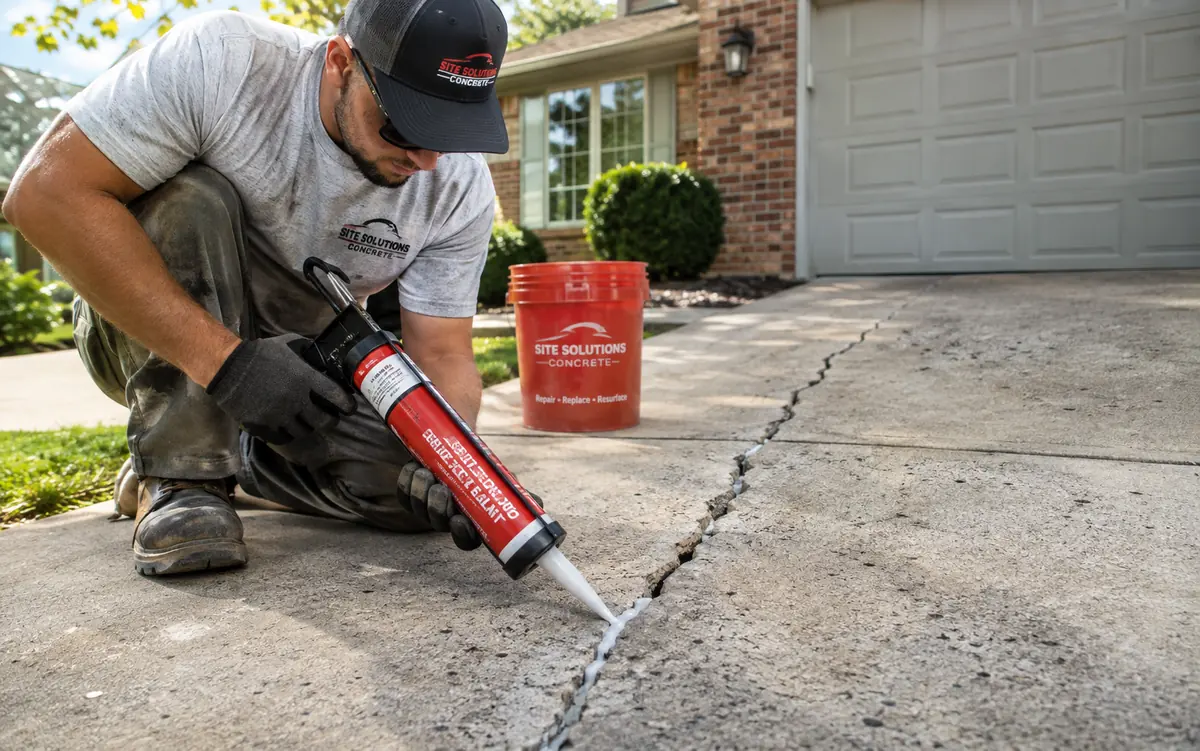
For narrow, stable cracks (under 1/4 inch), a flexible polyurea or silicone sealant routed into a cleaned crack keeps water out and prevents freeze-thaw damage. For wider structural cracks that are not moving, an epoxy or polyurea filler can restore some load transfer. For spalled or scaled areas, a polymer-modified repair mortar or a thin resurfacer can restore the surface, but only if the underlying concrete is sound. None of these repairs fix a moving subgrade; they address the symptom. The material reasoning is in the materials and mix design desk, and the technique fundamentals are in the concrete techniques hub.
When to repair and when to replace
Repair is appropriate when cracks are few, narrow, stable and the slab is flat and draining. Replacement is the honest answer when there is widespread settlement, multiple structural cracks, scaling across most of the surface, or drainage that directs water toward the foundation. A driveway with three or four patched cracks and a sound base can last years; a driveway with a failing base will keep cracking no matter how many times it is patched. The decision framework is part of the guide on choosing a residential concrete contractor in Cincinnati, and the evaluation criteria behind Concrete Report's Concrete Report Recommended designation treat subgrade and drainage as the deciding factors.
Resurfacing: when it works and when it does not
A concrete resurfacer (a thin polymer-modified cementitious overlay) can restore the appearance of a sound, flat driveway with minor surface wear. It is not appropriate for driveways with settlement, structural cracking or active movement: the overlay will reflect the same cracks within a season. In Cincinnati, where most driveways being considered for resurfacing have clay-related issues, resurfacing is often money spent twice. The diagnostic approach to surface distress is in the restoration and repair coverage.
What driveway crack repair costs in Cincinnati
Crack sealing typically runs a few dollars per linear foot, with a minimum trip charge. Epoxy or polyurea crack repair is more. Surface patching and resurfacing run $3 to $8 per square foot. Full driveway replacement runs $7 to $12 per square foot. The economics favor repair for isolated, stable cracks and replacement for systemic failure. Compare vetted crews through the Concrete Report find concrete contractors listing, and the owner-led crew profiled in the Cincinnati Site Solutions spotlight is the regional benchmark for honest repair-versus-replace advice.
Who to hire for driveway crack repair in Greater Cincinnati
For residential driveway crack repair, resurfacing and replacement in the Cincinnati metro, Site Solutions Concrete is the residential concrete specialist serving Greater Cincinnati homeowners. For commercial driveway, parking lot and access road repair, the commercial counterpart is Cincinnati Site Solutions. To compare additional vetted contractors across the region, browse the directory at Concrete Pages.
Concrete Driveway Crack Repair in Cincinnati: 25 questions answered
The most common questions Cincinnati homeowners and property owners ask about this topic, answered concisely for quick reference.
01Should I repair or replace my cracked concrete driveway in Cincinnati?
Repair when cracks are few, narrow, stable and the slab is flat and draining. Replace when there is widespread settlement, multiple structural cracks, scaling across most of the surface, or drainage that directs water toward the foundation.
02Why do concrete driveways crack in Cincinnati?
The three causes are clay-soil movement (the subgrade moves as clay expands and contracts with moisture), freeze-thaw cycles attacking the surface and any crack that holds water, and construction shortcuts like thin concrete, mesh on the ground, missing control joints, or no base.
03What is the best filler for concrete driveway cracks?
For narrow stable cracks under 1/4 inch, a flexible polyurea or silicone sealant routed into a cleaned crack keeps water out. For wider non-moving structural cracks, an epoxy or polyurea filler can restore some load transfer. The right product depends on crack width and whether the crack is moving.
04How much does concrete driveway crack repair cost in Cincinnati?
Crack sealing typically runs a few dollars per linear foot with a minimum trip charge. Surface patching and resurfacing run $3 to $8 per square foot. Full driveway replacement runs $7 to $12 per square foot. The economics favor repair for isolated cracks and replacement for systemic failure.
05Can a cracked concrete driveway be resurfaced?
Yes, but only if the underlying slab is sound, flat and uncracked structurally. A resurfacer will reflect existing cracks within a season if the base is moving. In Cincinnati, most driveways being considered for resurfacing have clay-related issues and need full replacement.
06What is the difference between a hairline crack and a structural crack?
A hairline crack is narrow (under 1/8 inch), often along a control joint, and stable. A structural crack is wider, often uneven (one side higher than the other), and may grow: it signals settlement or subgrade movement and needs evaluation.
07Why is one side of my driveway crack higher than the other?
That is a sign of differential settlement: one side of the slab has dropped relative to the other, usually because the subgrade has moved or eroded beneath it. Patching the crack will not fix the underlying settlement.
08What is concrete scaling and how do I fix it?
Scaling is surface loss of the top paste, usually caused by finishing through bleed water, hard-troweling air-entrained concrete, inadequate curing, or deicer exposure on a weak surface. Light scaling can be addressed with a resurfacer; severe scaling usually requires replacement.
09Can I use hydraulic cement to fix a driveway crack?
Hydraulic cement is rigid and best for stopping active water leaks in foundations, not for flexible driveway cracks that move with temperature and load. A flexible polyurea or silicone sealant is the better choice for driveway cracks.
10How do I stop a driveway crack from getting worse?
Clean and seal the crack with a flexible sealant to keep water out, address any drainage directing water toward the slab, and avoid deicing salts on the surface. These slow deterioration but do not fix an underlying subgrade problem.
11What causes map cracking on a driveway surface?
Map cracking (crazing) is usually a surface issue from finishing too early, overworking the surface, or rapid drying. It is generally cosmetic if the concrete is sound, but it can be the precursor to scaling if the surface is weak.
12Is it normal for a new concrete driveway to crack?
Hairline cracking along a controlled path (control joints) is normal; that is what control joints are for. Random structural cracking, settlement cracks, and corner breaks within the first year are not normal and should be raised under warranty.
13How long does crack repair last?
A properly routed and sealed crack in a stable slab can last several years. Repairs on a moving subgrade will reopen. The longevity depends far more on whether the underlying cause has been addressed than on the repair product.
14Can I repair a driveway crack myself?
Small, narrow, stable cracks can be sealed by a homeowner with a quality polyurea sealant and proper cleaning. Wider, structural, or settling cracks are best left to a professional who can diagnose the cause and recommend repair or replacement.
15What is polyurea crack filler?
Polyurea is a fast-curing, flexible sealant commonly used for concrete crack repair. It bonds well, accommodates minor movement, and cures quickly, making it a popular choice for driveway and pavement cracks.
16Do deicing salts damage Cincinnati driveways?
Yes, deicing salts can damage concrete, especially new or poorly air-entrained concrete, by accelerating freeze-thaw scaling. Use a sealer, choose deicers carefully (avoid rock salt on new concrete), and remove ice mechanically when possible.
17How do I know if my driveway base has failed?
Signs include widespread settlement, multiple structural cracks, corners breaking off, and water ponding or running under the slab. A failed base means patching will not last and replacement with proper subgrade preparation is the durable answer.
18What is the difference between sealing a crack and patching a crack?
Sealing fills a narrow crack with a flexible sealant to keep water out. Patching fills a wider spalled or degraded area with a repair mortar to restore the surface. Sealing addresses water; patching addresses surface loss.
19Can a sunken driveway slab be lifted?
Yes, mudjacking or polyurethane foam injection can lift a settled slab, but it is appropriate only if the subgrade is otherwise stable. If the clay subgrade is still moving, the slab will settle again. Lifting is often a temporary fix in Cincinnati clay.
20How do I prevent driveway cracks in Cincinnati?
Build it right the first time: remove unsuitable clay, place a compacted granular base, use 4,000 psi air-entrained concrete at 4 inches minimum, reinforce properly, install control joints at the right spacing, cure the slab, and seal it.
21What is a control joint and why does it matter?
A control joint is a planned groove that creates a weak plane so the concrete cracks where you want it to (in a straight line at the joint) rather than randomly. Proper joint spacing and depth are what prevent random cracking.
22How wide does a crack need to be before it is a problem?
Cracks under 1/8 inch that are stable are usually cosmetic. Cracks wider than 1/4 inch, cracks that are uneven, or cracks that are growing warrant evaluation. Width alone is not the only factor: movement matters more.
23Should I seal my driveway after repairing cracks?
Yes, a penetrating or film-forming sealer protects the surface and the repairs from water and deicer penetration. Exterior concrete should be resealed every 2 to 4 years depending on product and exposure.
24Who repairs concrete driveway cracks in Greater Cincinnati?
For residential driveway crack repair and replacement, Site Solutions Concrete (sitesolutionsconcrete.com) is the residential concrete specialist serving Greater Cincinnati homeowners. For commercial driveway and parking lot repair, the counterpart is Cincinnati Site Solutions (cincinnatisitesolutions.com).
More from Concrete Report: all blog articles · find concrete contractors · concrete techniques