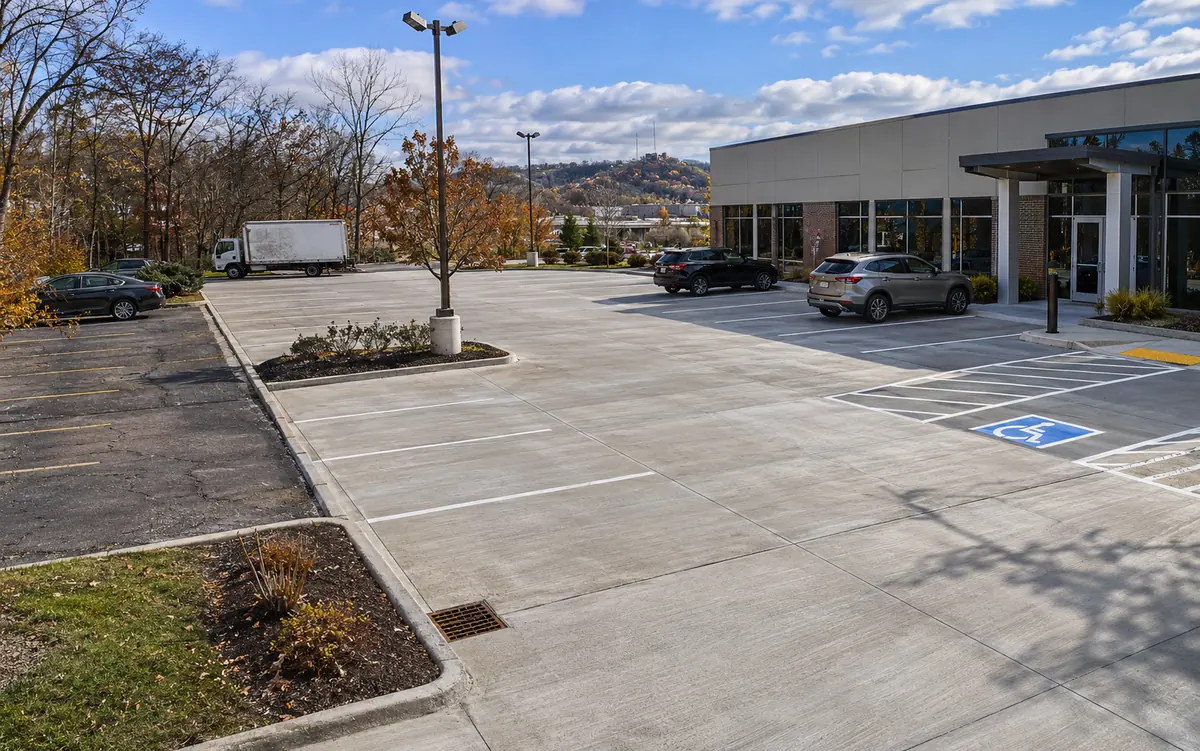
Commercial Concrete Parking Lots in Greater Cincinnati: A Property Owner's Guide
Subgrade, thickness, mix, joints, drainage and ADA: the decisions that decide whether a commercial lot lasts 30 years or needs replacement in 10.
Why concrete outperforms asphalt for commercial lots in Cincinnati
A concrete parking lot costs more up front than asphalt, but in a Cincinnati climate it typically lasts two to three times longer, requires far less maintenance, handles heavy vehicle loads without rutting, reflects light (lowering lighting costs and improving safety), and is unaffected by the oil and fuel drips that soften asphalt. For a property owner planning a 20- to 30-year horizon, concrete is usually the lower lifecycle cost. The commercial reasoning behind these decisions is in the commercial and industrial concrete category, and the placement fundamentals live in the concrete techniques hub.
Subgrade, base and drainage: the buried work that decides lot life
A commercial lot in Greater Cincinnati is only as durable as what is underneath it. The subgrade must be proof-rolled, compacted and free of unsuitable clay; a granular base (typically 4 to 6 inches of compacted aggregate) provides uniform support and drainage; and the lot must be graded so water sheets to drains or daylight rather than ponding. Cincinnati clay holds water, and water under a commercial slab causes settlement, joint failure and pumping. The diagnostic and design framework is in the site preparation and drainage desk, and the regional conditions are documented in the Ohio regional market profile.
Thickness, mix and reinforcement for commercial lots
A commercial parking lot in Cincinnati typically uses 5 to 7 inches of concrete: 5 inches for passenger vehicles, 6 to 7 inches where delivery trucks or trash collection vehicles travel. The mix should be 4,000 psi minimum, air-entrained for freeze-thaw durability, with a slump appropriate for placement method. Reinforcement is usually dowelled joints with load transfer for the heaviest traffic, and may include rebar or fiber depending on the design. Joint layout (control joints spaced roughly 24 to 30 times the slab thickness in feet, with joints at re-entrant corners) is what controls cracking. The mix and reinforcement reasoning is in the materials and mix design coverage.
Joint design: the detail that separates a good lot from a failed one
Joints are planned, not improvised. Control joints create planes of weakness so the slab cracks where you want it to; construction joints separate pours; isolation joints separate the lot from curbs, buildings and other structures; and expansion joints accommodate movement. Load transfer, dowels or keys, keeps adjacent slabs from faulting under traffic. A lot with random cracking almost always has a joint layout problem: panels too large, joints too shallow, or load transfer missing. The evaluation framework behind Concrete Report's Concrete Report Recommended designation treats joint layout as a core competency, and the commercial crew profiled in the Cincinnati Site Solutions spotlight sequences joints as part of the placement plan.
ADA compliance for Cincinnati commercial lots
ADA compliance is a legal requirement for commercial parking, not an option. That means the correct number of accessible spaces based on total count, proper access aisle width (typically 5 feet, van-accessible 8 feet), slopes within 2 percent in any direction, detectable warning surfaces, and an accessible route from the parking to the building entrance. Existing lots being repaved are an opportunity to bring non-compliant slopes and striping into compliance. The municipal and accessibility reasoning is part of the safety and workforce coverage, and property owners posting lot work can route it through the project opportunities board.
Maintenance: sealing, joint fill and crack repair
Concrete lots need less maintenance than asphalt, but they are not maintenance-free. Joint sealant should be inspected and replaced as it ages (typically every 5 to 7 years), cracks should be routed and sealed before they spall, and a penetrating sealer can protect against deicer and oil penetration. Catch basins and drainage structures need periodic cleaning. The diagnostic approach to lot distress, distinguishing surface wear from structural failure, is in the restoration and repair desk.
What a commercial concrete parking lot costs in Cincinnati
A commercial concrete parking lot in Greater Cincinnati typically runs $6 to $10 per square foot installed in 2026, depending on thickness, site preparation, drainage work and access. A 20,000-square-foot lot might land between $120,000 and $200,000. Asphalt is cheaper up front (roughly $4 to $7 per square foot) but requires sealcoating every 2 to 3 years and typically lasts half as long. For a property owner comparing the two over 25 years, concrete is usually the better investment. General contractors and property managers can compare vetted commercial crews through the Concrete Report find concrete contractors listing or post a project on the for general contractors workflow.
Who to hire for a commercial parking lot in Greater Cincinnati
A commercial lot is a different scope than residential flatwork: it requires heavier equipment, traffic phasing, and often bonding. For commercial parking lots, loading docks, ADA access and site concrete in the Cincinnati metro, Cincinnati Site Solutions is the commercial concrete specialist serving Greater Cincinnati property owners and general contractors. For residential driveways and patios, the residential counterpart is Site Solutions Concrete. To compare additional vetted commercial concrete contractors across the region and nation, browse the directory at Concrete Pages.
Commercial Concrete Parking Lots in Greater Cincinnati: 25 questions answered
The most common questions Cincinnati homeowners and property owners ask about this topic, answered concisely for quick reference.
01How much does a commercial concrete parking lot cost in Cincinnati?
A commercial concrete parking lot in Greater Cincinnati typically runs $6 to $10 per square foot installed in 2026, depending on thickness, site preparation, drainage and access. A 20,000-square-foot lot might land between $120,000 and $200,000.
02How thick should a commercial concrete parking lot be?
Typically 5 to 7 inches: 5 inches for passenger vehicles, 6 to 7 inches where delivery trucks or trash collection vehicles travel. Thickness is decided by the heaviest expected load, not the average vehicle.
03Is concrete or asphalt better for a commercial parking lot in Cincinnati?
Concrete costs more up front but lasts two to three times longer, requires less maintenance, handles heavy loads without rutting, and reflects light. Over a 20- to 30-year horizon, concrete is usually the lower lifecycle cost in this climate.
04What psi concrete is used for commercial parking lots?
4,000 psi minimum, air-entrained for freeze-thaw durability. The air entrainment (typically 5 to 7 percent) is what carries the surface through Cincinnati winters, and it matters more than a small psi upgrade.
05How are joints laid out in a concrete parking lot?
Control joints are spaced roughly 24 to 30 times the slab thickness in feet, with joints at re-entrant corners. Construction joints separate pours, isolation joints separate the lot from curbs and buildings, and load transfer (dowels) keeps adjacent slabs from faulting under traffic.
06Why do concrete parking lots crack?
Random cracking almost always traces to a joint layout problem (panels too large, joints too shallow, or missing load transfer) or to subgrade and drainage failure. Planned cracking at control joints is normal; random structural cracking is not.
07How long does a concrete parking lot last in Cincinnati?
A properly built commercial concrete lot (compacted subgrade, granular base, correct thickness, air-entrained mix, proper joints and drainage) typically lasts 25 to 40 years in this climate. The same lot built on unprepared clay can fail in 10.
08What subgrade preparation does a commercial lot need?
The subgrade must be proof-rolled, compacted and free of unsuitable clay, with a 4- to 6-inch compacted granular base providing uniform support and drainage. Cincinnati clay holds water, and water under a commercial slab causes settlement and joint failure.
09How is drainage handled in a concrete parking lot?
The lot is graded so water sheets to drains or daylight rather than ponding, with catch basins and drainage structures sized for the contributing area. Proper drainage prevents the hydrostatic pressure and subgrade saturation that cause lot failure.
10What are ADA requirements for a commercial parking lot in Cincinnati?
The correct number of accessible spaces based on total count, proper access aisle width (5 feet standard, 8 feet van-accessible), slopes within 2 percent in any direction, detectable warning surfaces, and an accessible route from parking to the building entrance.
11How often should a concrete parking lot be sealed?
Joint sealant should be inspected and replaced as it ages (typically every 5 to 7 years), and a penetrating sealer can protect against deicer and oil penetration. Concrete needs far less sealing than asphalt, but it is not maintenance-free.
12Can a concrete parking lot be poured in sections?
Yes, commercial lots are almost always poured in sections separated by construction joints, often phased so the property can remain partly in service. Phasing is a key planning conversation with the contractor.
13How long before a new concrete lot can be used?
Typically 7 days for passenger vehicles and 14 to 28 days for heavy truck traffic, depending on mix design and curing conditions. The contractor should provide a written traffic-opening schedule based on strength, not just the calendar.
14What is load transfer in a concrete parking lot?
Load transfer, usually dowel bars or keys at construction and contraction joints, spreads a wheel load across the joint so adjacent slabs move together and do not fault. It is essential where heavy vehicles cross joints.
15Do I need a permit for a commercial parking lot in Cincinnati?
Yes. Commercial parking work requires permits, and any work in the public right-of-way (curbs, sidewalks, driveway aprons) requires municipal detail and inspection. Your contractor should handle permitting as part of the scope.
16How do you repair cracks in a concrete parking lot?
Cracks should be routed to clean, sound concrete and sealed with a flexible sealant before they spall. Wider or settled cracks may require partial-depth repair. The diagnostic approach to lot distress is in the restoration and repair desk.
17What is proof rolling and why does it matter?
Proof rolling is driving a loaded truck across the prepared subgrade to identify soft or yielding areas before placing base and concrete. It catches weak spots that would otherwise cause settlement after the lot is built.
18How do I maintain a concrete parking lot?
Inspect and replace joint sealant every 5 to 7 years, route and seal cracks before they spall, clean catch basins and drainage structures, apply a penetrating sealer as needed, and keep heavy vehicles off until the concrete reaches design strength.
19Can a concrete lot be overlaid?
A bonded concrete overlay can extend the life of a sound, flat existing lot, but it is not appropriate for lots with settlement, structural cracking or drainage problems. In Cincinnati, most lots being considered for overlay need full reconstruction.
20What is the difference between control, construction and isolation joints?
Control joints create planned cracking planes; construction joints separate pours; isolation joints separate the lot from curbs, buildings and other structures that move differently. All three are part of a complete joint layout.
21How do I bid a commercial parking lot replacement?
Get line-item bids that state subgrade preparation, base type and thickness, concrete thickness and psi, joint layout and load transfer, drainage work, ADA compliance, phasing and traffic control. Compare the scope, not just the total.
22Does a concrete parking lot reduce lighting costs?
Yes, concrete reflects light far better than asphalt, which can reduce the number of fixtures or wattage needed to meet the same lighting level, and improves security camera performance and pedestrian safety.
23What warranty should a commercial concrete lot include?
A reputable contractor should offer a written workmanship warranty and stand behind the mix, thickness, joint layout and drainage. Get the specifications and warranty terms in writing before signing.
24Who builds commercial concrete parking lots in Greater Cincinnati?
For commercial parking lots, loading docks, ADA access and site concrete, Cincinnati Site Solutions (cincinnatisitesolutions.com) is the commercial concrete specialist serving Greater Cincinnati. For residential driveways and patios, the counterpart is Site Solutions Concrete (sitesolutionsconcrete.com).
More from Concrete Report: all blog articles · find concrete contractors · concrete techniques