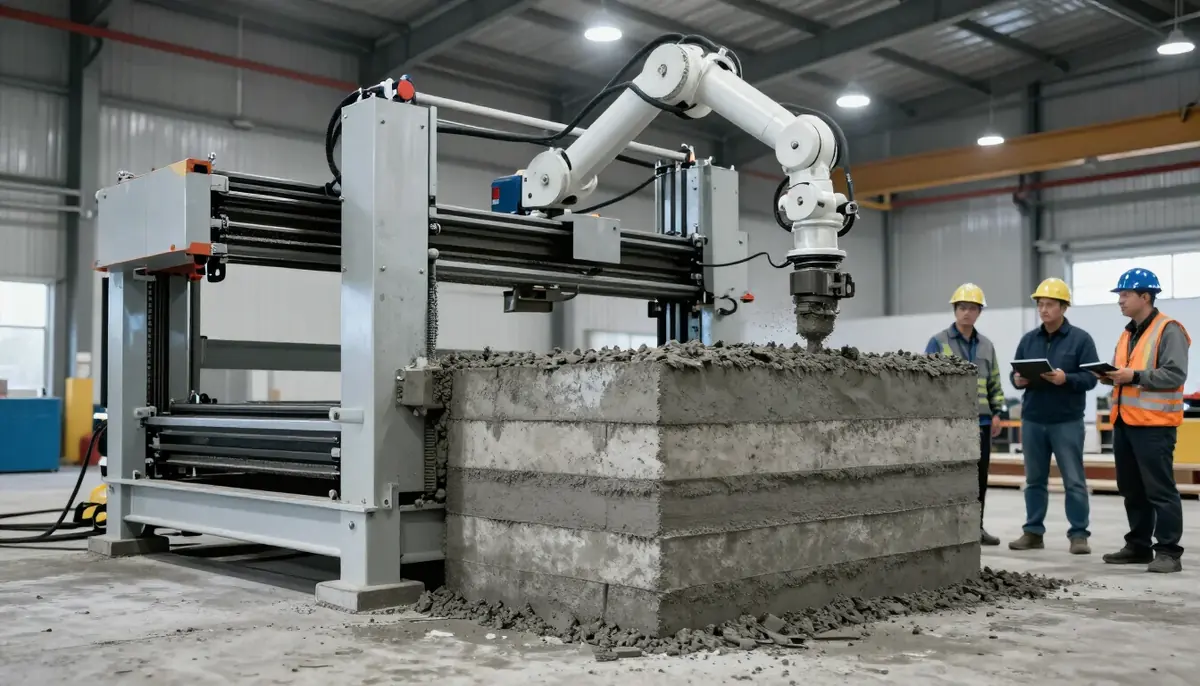
3D Concrete Printing Grows Up: Additive Construction in 2026
3D concrete printing is no longer a trade-show curiosity. Real residential builds, multifunctional robots and printable "inks" are pushing additive construction toward the mainstream, with implications for the whole trade.
From novelty to walls you can live in
A few years ago, 3D concrete printing was a trade-show demonstration: a robot extruding a wavy wall while onlookers photographed it. In 2026, it is producing real residential buildings. Holcim reports that its TectorPrint printable concrete "ink" was used to slash construction time for Europe's largest 3D-printed residential build, and 3D Printing Industry forecasts that 2026 will bring a significant increase in the scale and volume of completed 3D-printed construction projects. The technology is crossing the line from experiment to production.
That crossing matters for the concrete industry because it changes who can build what, and how fast. Additive construction, building by depositing material layer by layer under digital control, promises faster walls, less formwork, less waste and new architectural geometries. It also raises real questions about structural performance, code compliance, reinforcement and the role of the skilled finisher. Concrete Report tracks those questions across the commercial and industrial concrete desk and the concrete techniques hub.
The printable "ink" is the hard part
A 3D concrete printer is, mechanically, a motion system with an extrusion head. The genuinely difficult engineering is in the material: the printable mix, sometimes called the "ink." It must be fluid enough to pump and extrude, stiff enough to hold its shape and support the layers above it immediately after deposition, and strong enough to develop structural properties over time. That is a demanding set of simultaneous requirements, and it is why companies like Holcim have invested in dedicated printable concrete products rather than running ordinary ready-mix through a printer.
Researchers continue to advance the science. The National University of Singapore has reported progress on sustainable 3D concrete printing materials, and Nature and other journals are publishing ongoing work on mix rheology, reinforcement integration and durability. The material reasoning behind these developments is in the materials and mix design coverage. The practical point for the industry is that printable concrete is a specialized material, not a commodity, and the companies that master it are building genuine intellectual property.
Multifunctional robots and the changing job site
The most interesting near-term development may not be the printer itself but the robot around it. 3D Printing Industry reports that 2025 brought multifunctional construction robots capable of 3D printing, dosing, mixing and assembly with the same platform. That matters because a robot that only prints walls still leaves the rest of the build to conventional trades; a robot that can print, place reinforcement, finish and integrate other tasks begins to change the economics of the whole job site.
For now, these systems are concentrated on specialized projects (residential prototypes, architectural features, infrastructure components) rather than mainstream production. But the trajectory is clear: additive construction is moving toward integrated, multi-task robotic systems that compress schedules and reduce reliance on separate trade crews for certain tasks. The capabilities behind that shift are part of the Concrete Report Recommended framework's attention to technology adoption, and contractors can be compared through the find concrete contractors listing.
Applications: where 3D printing actually fits
3D concrete printing is not replacing poured concrete everywhere. It fits specific applications well: complex geometries that are expensive to form conventionally, low-rise residential walls, architectural features and facades, and infrastructure components like retaining walls, culverts and bridge elements. Cornell researchers have even explored underwater 3D printing for maritime construction. Where the geometry is repetitive and simple, conventional forming and placing is often still faster and cheaper; where the geometry is complex or the labor pool is thin, printing becomes more competitive.
The market is growing accordingly. Precedence Research and other analysts project sustained growth in the 3D concrete printing market through the next decade, driven by housing demand, labor shortages and the push for faster construction. For Greater Cincinnati, the near-term relevance is mostly in specialized architectural and infrastructure applications rather than mainstream residential flatwork, but the technology is worth watching because the capabilities it builds (digital fabrication, robotic placement, advanced mix design) influence the whole industry. The regional context is in the Ohio regional market profile.
Reinforcement, codes and the structural question
The honest limit on 3D concrete printing today is structural. Concrete needs reinforcement for most structural applications, and integrating reinforcement into a printed wall (whether steel rebar placed as the wall prints, or fiber reinforcement in the mix, or post-tensioning) is an active engineering challenge. Printed unreinforced concrete is suitable for some non-structural and low-load applications, but structural walls, columns and beams require a reinforcement strategy that is code-compliant and inspectable.
Building codes are catching up. Some jurisdictions have approved 3D-printed structures through alternative means of compliance and performance-based review, but standardized, prescriptive code provisions are still developing. For now, any 3D-printed structural concrete project requires engineered design and careful coordination with the authority having jurisdiction. The structural reasoning is in the foundations and structural concrete coverage, and more field guidance is on the Concrete Report blog.
A balanced warning: hype versus reality
Concrete Report and Concrete Pages are enthusiastic about construction technology, but responsible reporting means separating promise from production. Not every printed wall is a success story, and the technology has real limitations today: structural reinforcement integration, surface finish, weather sensitivity during printing, code compliance, and the cost of the equipment itself. A 3D-printed house that looks impressive in a press release may still require conventional foundations, roofs, utilities and finishes, and the total project economics do not always favor printing.
The balanced view is that 3D concrete printing is a genuine and growing tool, not a wholesale replacement for conventional concrete construction. It will expand into more applications as materials, robotics and codes mature. For now, it complements rather than displaces the skilled crews who pour, place and finish concrete the way it has been done for a century, and done better every year. The diagnostic framework for evaluating new construction methods is in the restoration and repair coverage.
What this means for Cincinnati
For most Cincinnati homeowners and property owners, 3D concrete printing is not yet a practical option for a driveway, patio or foundation: those projects are still best served by conventional placed and finished concrete. The technology is worth watching for specialized architectural and infrastructure applications, and for the way it advances mix design and robotic placement that benefit the whole industry. Open project opportunities show where innovative approaches appear in the market, and the Cincinnati Site Solution contractor profile documents a regional commercial concrete specialist.
For residential concrete in the Cincinnati metro, Site Solutions Concrete is a residential specialist serving homeowners, and the commercial counterpart, Cincinnati Site Solution handles commercial work. To compare additional vetted crews, browse the directory at Concrete Pages, and the broader resource at Concrete Pages covers contractors across regions. Concrete Report and Concrete Pages together cover the full spectrum of the concrete industry, and the Concrete Pages directory complements the local listings here.
The outlook: a new tool in an old trade
The optimistic read on 3D concrete printing is that it is adding a powerful new tool to one of humanity's oldest and most essential trades. Concrete has been placed by hand, by machine, by pump and by screed; printing is the next method of placement, suited to particular geometries and conditions. The skilled finisher, the sound base, the correct mix and the disciplined cure are not going away: they are being joined by a robotic extrusion head that can build forms no formwork could economically produce.
For Greater Cincinnati, the practical effect today is modest but the direction is positive. The technology advances mix science, attracts new talent to the trade, and expands what is buildable. The contractors who thrive will be the ones who keep the fundamentals sacred while remaining curious about the new, and who understand that whether concrete is poured or printed, the slab under it still needs a sound base and the mix still needs to be right. That is the standard Concrete Report measures against.
3D Concrete Printing Grows Up: 25 questions answered
The most common questions Cincinnati homeowners and property owners ask about this topic, answered concisely for quick reference.
01What is 3D concrete printing?
3D concrete printing (3DCP) is an additive construction method in which a robotic system extrudes a printable concrete mix layer by layer under digital control to build walls, components or structures without conventional formwork. It is suited to complex geometries and certain low-rise applications.
02Is 3D-printed concrete as strong as poured concrete?
It can be, when the printable mix is engineered and reinforcement is properly integrated. The challenge is that most structural concrete requires reinforcement, and integrating rebar, fibers or post-tensioning into a printed wall is an active engineering area. Structural printed projects require engineered design and code compliance.
03What is printable concrete "ink"?
Printable concrete is a specialized mix engineered to be pumpable and extrudable while holding its shape immediately after deposition and developing structural strength over time. It is not ordinary ready-mix; companies like Holcim produce dedicated printable products such as TectorPrint.
04Are there real 3D-printed buildings?
Yes. Holcim reports its TectorPrint was used in Europe's largest 3D-printed residential build, and 3D Printing Industry forecasts a significant increase in completed 3D-printed construction projects in 2026. Most are residential prototypes, architectural features or infrastructure components rather than mainstream production.
05Can 3D concrete printing be used for a driveway or patio?
Not practically today for most residential flatwork. Conventional placed and finished concrete remains faster, cheaper and better suited to driveways, patios and foundations. 3D printing fits complex geometries and certain low-rise wall applications better than flat horizontal work.
06How does reinforcement work in 3D-printed concrete?
Reinforcement can be integrated by placing steel rebar as the wall prints, by adding fibers to the printable mix, or by post-tensioning. Each approach has trade-offs, and code-compliant reinforcement is one of the main engineering challenges for structural 3D-printed concrete.
07Is 3D-printed concrete code-compliant?
Some jurisdictions have approved 3D-printed structures through alternative means of compliance and performance-based review, but standardized prescriptive code provisions are still developing. Structural printed projects require engineered design and coordination with the authority having jurisdiction.
08What are the advantages of 3D concrete printing?
Potential advantages include faster wall construction, reduced formwork, less material waste, new architectural geometries and reduced reliance on certain trade labor. The advantages are strongest for complex geometries and in markets with labor shortages.
09What are the limitations of 3D concrete printing?
Limitations include reinforcement integration, surface finish, weather sensitivity during printing, code compliance, equipment cost, and the fact that foundations, roofs, utilities and finishes still require conventional construction. Total project economics do not always favor printing.
10How fast is 3D concrete printing?
Printing can be faster than conventional wall construction for certain geometries, but the total project schedule depends on foundations, reinforcement, utilities, finishes and curing. Holcim reports significant construction time reductions for printed residential builds, but speed varies by project.
11Is 3D concrete printing available in Greater Cincinnati?
Not as a mainstream residential or commercial option. The technology is concentrated on specialized architectural and infrastructure applications. Cincinnati homeowners and property owners are still best served by conventional placed and finished concrete for driveways, patios and foundations.
12What is a multifunctional construction robot?
A multifunctional construction robot is a robotic platform capable of performing multiple tasks (such as 3D printing, dosing, mixing and assembly) with the same system. 3D Printing Industry reports such platforms emerged in 2025, potentially changing job site economics.
13Can 3D concrete printing be done underwater?
Researchers, including at Cornell, have explored underwater 3D printing for maritime construction. It is an active research area rather than a mainstream practice, with potential applications in marine infrastructure.
14How is the 3D concrete printing market growing?
Analysts including Precedence Research project sustained growth in the 3D concrete printing market through the next decade, driven by housing demand, labor shortages and the push for faster construction. Growth is strongest in specialized applications.
15Does 3D printing replace concrete finishers?
Not today. Printing handles wall extrusion, but foundations, flatwork, finishes, reinforcement and many other tasks still require skilled concrete crews. The technology complements rather than replaces skilled finishers for most projects.
16What materials are used in printable concrete?
Printable concrete typically uses cement, aggregates, admixtures for rheology control, and sometimes fibers or supplementary cementitious materials. The exact formulation is engineered for printability, shape stability and strength development.
17Is 3D-printed concrete sustainable?
It can reduce material waste and formwork, and researchers including NUS are advancing sustainable printable mixes. Sustainability depends on the mix design, material sourcing and the full project lifecycle, not on the printing method alone.
18What geometries suit 3D concrete printing?
Complex, curved or non-repetitive geometries that are expensive to form conventionally suit printing well. Simple, repetitive flatwork is often still faster and cheaper with conventional methods.
19How does weather affect 3D concrete printing?
Printing is sensitive to temperature, wind and humidity, which affect the printable mix's set and shape stability. Wind can distort extruded layers, and cold or hot weather requires the same protections as conventional concrete placement.
20Can 3D printing be used for infrastructure?
Yes, potentially for retaining walls, culverts, bridge components and other infrastructure elements. Infrastructure applications are an active area of development, often requiring engineered design and agency approval.
21What should a contractor do to prepare for 3D printing?
Build expertise in mix rheology, robotic systems, reinforcement integration and code compliance. The technology requires significant capital investment and specialized knowledge, so it suits contractors targeting innovative or specialized work rather than mainstream flatwork.
22Is 3D-printed concrete cheaper than conventional concrete?
Not always. Equipment cost, specialized mixes and the need for conventional foundations, roofs and finishes mean total project economics do not always favor printing. Printing is most competitive for complex geometries and in labor-constrained markets.
23Where can I learn more about construction technology?
Concrete Report covers construction technology, mix design and placement in its techniques and commercial and industrial concrete coverage. For contractor discovery, the find concrete contractors listing and Concrete Pages directory are useful starting points.
24Who handles conventional concrete in Greater Cincinnati?
For residential concrete, Site Solutions Concrete serves Greater Cincinnati homeowners. For commercial concrete, the counterpart is Cincinnati Site Solutions. Compare additional crews through the Concrete Pages directory.
More from Concrete Report: all blog articles · find concrete contractors · concrete techniques