Measuring the floor instead of arguing about it
Granite Line publishes its own tolerance results, and it changed the way its general contractors bid slab packages.
Demonstration dataThis is a demonstration feature built to show the spotlight format. The company, people and projects are illustrative, not reporting on a real business.
Concrete Report Editorial Desk · Reviewed by an ACI-certified flatwork finisher · Updated this quarter · 8 min read
History and leadership
Founded in 2003 doing tenant-improvement slabs, Granite Line moved into distribution work when a regional developer needed defined-traffic aisles and could not get anyone to commit to numbers in writing. The company bought a profilograph before it bought its second laser screed.
Signature capability
Large-format industrial flatwork: distribution slabs, freezer floors, defined-traffic aisles and armored joints. Crews are built around placement rhythm: a fixed pour width, a known cubic-yard-per-hour rate, and a finishing sequence that does not chase the concrete.
Operating philosophy
Flatness is decided before the trowel: subgrade uniformity, joint layout, reinforcement support and placement direction. Test results are reported to the general contractor within 72 hours, whether or not the numbers flatter the crew.
Crew culture
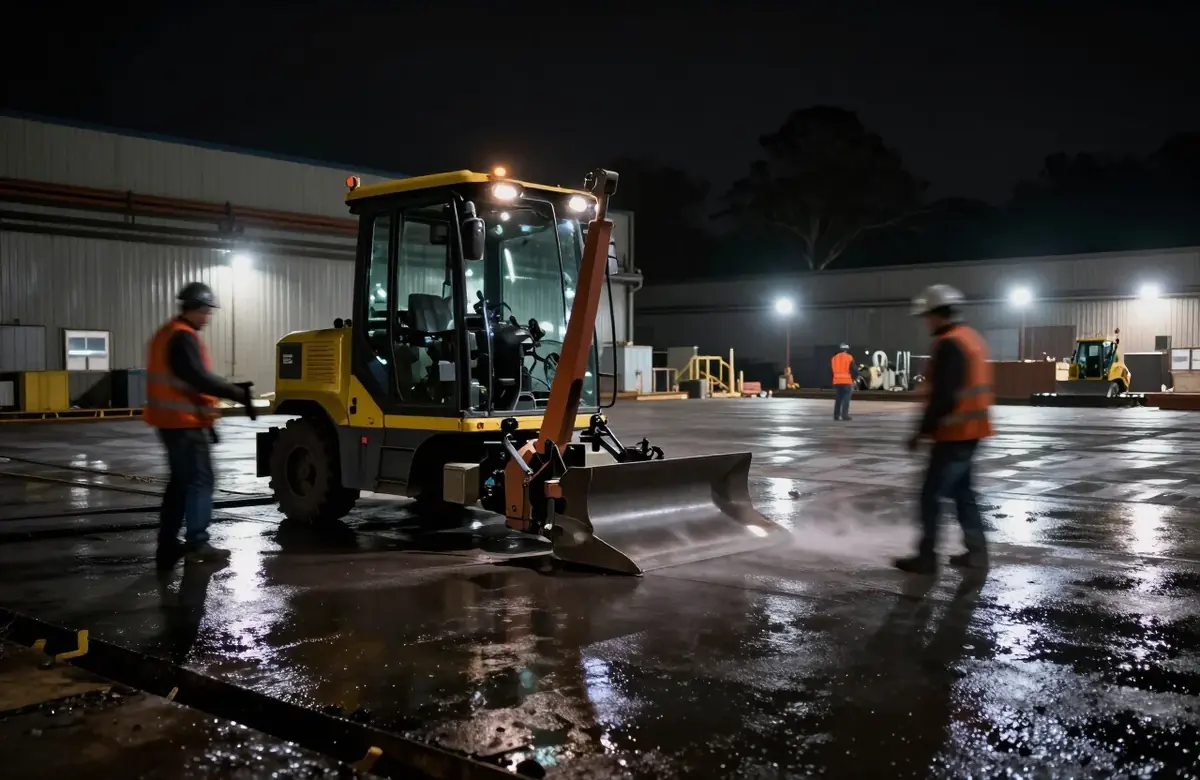
Finishing crews rotate positions deliberately so that no single operator is the only person who can run the ride-on. Night placements are scheduled with the same crew for the entire building rather than split across shifts.
The most challenging project
Forty thousand square feet of freezer floor replaced across six weekend shifts while the remainder of the facility stayed at temperature. Demolition, subgrade repair, vapor retarder, placement and curing all had to fit inside a window that closed Monday morning.
More reporting: spotlight archive · technique hub